


Art, Nature and Consciousness
February 28, 2013

An Interview with an Artist and His Gallerist

by Linda Egenes


Naoto Nakagawa comes from a long line of Japanese poets, artists, and philosophers. After growing up in Takarazuka, Japan, he emigrated to New York City as a teenager in 1962 and quickly established himself as a painter and performance artist. His paintings have appeared in over 25 solo exhibitions in leading New York galleries and in group exhibitions at the Guggenheim Museum, the San Francisco Museum of Modern Art, and the Venice Biennale. His work is included in many public and private collections in the USA, Europe, and Japan, including the New York Museum of Modern Art and the National Museums of Modern Art in Osaka and in Kyoto. Nakagawa has taught and lectured at, amongst others, Columbia University and Parsons School of Design.

Hudson, the owner of the gallery Feature Inc., was profiled in the December 2012 issue of Art in America. As a dealer noted for introducing many popular artists, such as Jeff Koons, Richard Prince, Raymond Pettibon, Tom Friedman, and Takashi Murakami, he is a leading figure in the American contemporary art scene.

One spring morning, Enlightenment met with Naoto and Hudson while they were preparing a solo exhibition of Naoto’s most recent work, his “Earth Wave Paintings,” at Hudson’s gallery. In this fascinating discussion, they explore the role of nature and consciousness in Naoto’s work as well as the influences of both the artist and gallerist in the process of making art.

Naoto Nakagawa


Enlightenment: How does nature play a role in your art?

Naoto: In the area near Kobe where I grew up there is a beautiful river—the Muko River —and beyond it is the majestic Mt. Rokko. Almost every evening, I would sit on a rock in the garden and look at the mountain and watch that magical moment of nature—sunset—when the sky turns red, orange, and yellow. I saw hundreds of teeming bats, dragonflies, and mosquitoes, each aiming to eat the other. This abundance of nature is gone, unfortunately, as so many houses have been built there now. The beauty and magic of nature that I experienced is no longer there, but that experience is deep inside of me.

I remember reading the autobiography of Arshile Gorky, an important artist who came to America from Armenia and is known to be the link between the European art movement and the American movement—a bridge from Picasso to Matisse to abstract expressionism. He painted symbolic nature, involving natural forms, abstractions, and life-and-death kinds of feelings.

An interviewer once asked him, “Where do your images come from?” and he said they came from nature. He grew up in Armenia until he was about 13 years old, and the way he described his deep connection to nature there, I thought, “Wow! This is very similar to my own experience.” His creative process is like a memory. So I must be doing something like that, too.

Hudson: Nature is probably the unifying factor in all the art that you’ve made. Each piece is a different expression of that central theme.

Enlightenment: Has the practice of meditation helped your painting to evolve in this direction?

Naoto: Yes. If you look at my paintings up to 1972, they were very much about manmade objects, such as a comb making love to a stick of butter. I was thinking of a second, urban nature defined by Marshall McLuhan—a manmade world created by humans. There was no natural, organic thing, no trees or leaves or flowers in those paintings.

Then there is a perceptible shift in my paintings in 1973, only one year later. People often ask, “What happened to your art between ’72 and ’73?” I learned to meditate for the first time in 1972. I think before I started Transcendental Meditation I was a kind of artist-in-rage or something. I had arrived in this big city. I felt foreign. I felt alienated. At the same time I wanted to be accepted and to participate. And I had some very good dealers exhibiting my work.

But when I began to meditate I went deep inside of myself for the first time. It was the thing I had been looking for, for a long time, but couldn’t find. And I think one of the wonderful things about practicing TM is that not only did it give me the experience of going deep inside, it also put me in touch with the source of my creative impulse. It gave me a knowledge of the wellsprings of my creative source in the deepest level of consciousness. We are always conscious of physical, tangible things, but TM gave me a tool to reach the source of thought. So that was a very big discovery for me.

In my work, there was a dramatic transformation from my early paintings of almost violent encounters between objects to a new, deeper connection to and acceptance of existence and the things around me. In my new still life paintings, a mysterious connectedness between objects emerged, and a few years later, when I moved to Vermont, nature made an appearance in my work. It was as if I found a correspondence with my youth in nature-filled Japan. As the years have passed, nature has taken more of a central role in my work.

We live in this vast universe and we’re very tiny, tiny beings, but we have inside us every attribute of the incredible universe. So the deeper I can go inside of myself, the more I should be able to bring new layers of perception to others. And when I began to meditate, it connected me to the universe; like a tube of electricity, it connected me.

Enlightenment: Can you explain the image that you described earlier as “a comb making love to butter?”

Naoto: Butter is sort of soft and organic, and the comb and scissors are sort of phallic symbols. And I think that this male-female combination, the manmade and the organic, continues today throughout my work.

Hudson: In your most recent work, the concentric rectangles could represent the more masculine forms and the imagery of the foliage and flowers could be said to represent the feminine. You have that interplay occurring in much of your earlier work as well. While it appears differently, essentially it’s the same discussion.

Naoto: Yes, I find that the fundamental nature of the creative process is the juxtaposition of maleness and femaleness. These two forces are opposed with each other but also they unite at the same time, so I like to put those two things together.

About a year ago, I was at Carnegie Hall with my wife, listening to Beethoven’s Ninth Symphony with about 200 choral singers, and half were female and half were male. It was the most amazing experience, an absolute contrast of the masculine and feminine. I think the truth of the universe has very much to do with this combination.

Enlightenment: This discussion reminds me of what art critic Eric Shiner wrote: “Naoto forces the viewer to make new associations, to think of alternative universes.” Another writer thought you could be called a mystical artist. What do you think of those comments?

Naoto: I think that may have something to do with the way I grew up in Japan. I carry a lot of Japanese influences within me. I feel very connected to my grandfather, Kagaku Murakami, who was a kind of mystic painter himself. He practiced a form of tantric meditation, and he always meditated before painting. Kagaku is known as the last great literati painter. Literati means “scholar-painter”—a tradition that goes back 700 years in China and Japan. He died in 1939, so I never really knew him, but I heard many stories about him from my mother.

He used to go up into the mountains and spend all day looking at nature, without sketching or drawing. I know exactly what he was looking for. Through his meditation he was getting in touch with the source of nature, the creative force.

When he died a publisher compiled his writings into a philosophy of art. I have read that book many times because it contains much wisdom. He wrote, “The act of painting is a prayer in a secret chamber.” I really love this passage because it’s so private and so spiritual. His legacy may have something to do with the way I connect with nature.

Enlightenment: One interviewer said something similar of your approach to your work—he described it as very devotional, very monk-like.

Naoto: When you paint you are not on stage. I’m not an actor, not doing something to please someone. It’s a very private act, and in order for a painter—at least for me—to create something extraordinary out of the ordinary, I have to shut myself off from the world and allow my consciousness to go inside as deep as I can to bring something extraordinary to the viewer. And I know for myself, when I see something extraordinary in art, it opens my eyes to new meanings, it raises my consciousness, and creates this tenderness, an appreciation for humanity and for life.

It’s like constructing a poem—a poet uses mundane words, but it’s how you put the puzzle together that makes it extraordinary. It’s the same with painting—everything I paint, whether it’s flowers or butter or scissors, is a mundane thing. But it’s how you paint it, how you combine them together, and the colors and the forms—if you can bring the magic out of them, you can make a great painting. That’s what it’s about. And I think that meditation is another vehicle to reach to the deepest level of my own consciousness, reflecting these beautiful forms.

Enlightenment: Naoto, I’m wondering how Hudson nurtures your creative process and how you worked together to create this exhibition?

Naoto: I don’t know how he does it, but Hudson has the ability to encourage, to draw something out of each of the artists he works with. My paintings have become more developed, more radical, more risk-taking. As a result, in many paintings I made a leap into completely new territory.

Hudson: Basically I observe, point to things or ideas, and make connections or comments; it is probably the underlying understanding, support, and appreciation that give strength to my presence. I don’t attempt to be definitive, as it’s the artist who has to make the decisions.

In this type of situation, much like a lot of the art I enjoy, I generally prefer a communication that is tangential or loosely circles around things rather than addressing these delicate and complex matters directly. I keep it open; the artist hones it down.

Naoto: And this may have something to do with us both being meditators. At first I didn’t know that he was a meditator.  And I don’t think he knew that I was a meditator.

I don’t know how we found out. I think there’s some kind of undercurrent, maybe something that we share deep down in our consciousness.

Enlightenment: You’ve both been practicing the Transcendental Meditation technique for over 40 years. In addition, Hudson has learned the TM-Sidhi℠ program, which is an advanced program. Hudson, do you also feel that this ability to see into each artist is connected with your meditation practice?

Hudson: Yes, of course. I feel there is an increased awareness that I have evolved to, and I feel that it comes out of meditation. It simply is. When you move from closing your eyes in meditation to opening your eyes and reengaging in the world, you feel that increased awareness. And after many years of doing that, the awareness lasts longer and it’s taken into the day.

Naoto: Sometimes people comment that I am very centered.  And I think that centeredness is like an anchor inside of me that’s really unshakeable. I think that meditating for so many years has something to do with this.

Enlightenment: And the future?

Naoto: The mountain is in front of me. So I keep climbing and hopefully I can reach the summit. I’m probably halfway up now. Probably I’m dreaming, but my obsession is to create paintings that are the most incredible works of art.

RELATED LINKS

I originally wrote this article for Enlightenment: The Transcendental Meditation Magazine, Issue 7, June 2012. Reprinted with permission. 

Kauai Aquaponics
December 22, 2012

Three stages of cracking a macadamia nut

The first day my husband and I arrived on Kauai’s north shore we were resting after meditation. Suddenly we became aware of two small eyes peering at us from the top of the stairs. Soon we were chatting with Micah, aged six, like we’d known him his whole life. Micah and his brother London, nine, were two of the best things about our trip–raised by their parents Dee Dee and Chris Almida, they were a constant source of information about surfing, herbal lore, native plants, and how to crack macadamia nuts.


London shares his garden creation.

And since we were staying in their treehouse guest room ( Mount Meru Hale airbnb), we were warmly welcomed into their family for ten days.

Kauai, it turns out is a sustainable living mecca. With growth carefully controlled, you get the feeling that the spirit of the island is running things instead of the tourists.


Our tour guide, Micah, teaching us about the taro plant garden.


To teach us how the native Hawaiians carefully managed their ecosystem, Dee Dee and Micah took us on a tour of the Limahuli Garden and Preserve (a National Tropical Botanical Garden). Dee Dee, Micah and London do volunteer work there once a week to help preserve and restore native species. The terraces are incredibly beautiful, and connect the top of the mountain to the lowlands around the shore in one ecosystem called an ahupua‘a  by the ancient Hawaiians.


The Almida family (Chris, Dee Dee, London and Micah) stand in front of their aquaponics project.

One thing we were curious about–what were those trays of water sitting in their driveway?
It turns out that Chris and Dee Dee are adventuring into a sustainable way to raise food. Having left their farm on the big Island four years earlier, they were looking for a way to farm without the back-breaking work. Aquaponics, I learned, is a symbiotic system that combines the best of fish farming with hydroponics farming.
The fish waste feeds the plants, and the plants feed the fish, purify the water and keep the fish healthy. The result is high-density green crops AND tasty fish in a short time. The Almida’s have joined forces with other islanders to bring aquaponics to Kauai on a commercial basis. With limited farmland on the island, it’s a smart sustainable solution for every family’s need to grow their own  fresh, organic food.

by Linda Egenes

Pam Peeke, MD, MPH, FACP, is the New York Times bestselling author of Body-for-Life for WomenFight Fat after Forty, and Fit to Live. Dr. Peeke is a Pew Scholar in nutrition and metabolism, assistant clinical professor of medicine at the University of Maryland, Fellow of the American College of Physicians, and a nationally recognized expert in nutrition, fitness, and public health. She is WebMD’s lifestyle expert, host of Discovery Health Channel’s Could You Survive series, and spokesperson for the American College of Sports Medicine’sExercise is Medicine global initiative.

Her latest book, The Hunger Fix: The Three-Stage Detox and Recovery Plan for Overeating and Food Addiction (Rodale), a New York Times bestseller launched on The Katie Couric show, explores the new brain science behind food addiction—offering a step-by-step detox and recovery plan to rewire the brain for healthy eating. Here she talks about the value of the Transcendental Meditation technique in strengthening the prefrontal cortex to overcome food addiction, a topic she also addresses in her book.

Enlightenment: What motivated you to write THE HUNGER FIX?

Dr. Peeke: For years I have listened to my patients referring to their eating problems using a drug vernacular. “I need another hit,” they would say, “Withdrawal is killing me,” or “I need to score some more.” In the back of my mind and that of my colleagues, I wondered if there was an addiction going on here.

Dr. Pam Peeke

“There’s not a single thing
we do that doesn’t involve reward… Reward drives behavior.”

At that time we had some compelling science that suggested a food and addiction link. But I needed more. I waited somewhat impatiently until there was a critical mass of data from neuroscientists and then wrote the book to translate this groundbreaking information for people in a way that can help them.

The first chunk of new science presented in the book—based on NIH research by Dr. Nora Volkow, Director of the National Institute of Drug Abuse, and others—is a real game-changer: Food addiction is real. For that matter, at the Weight of the Nation conference in Washington, D.C., last May, Kathleen Sebelius, Secretary of Health and Human Services, stated in her keynote address, “Obesity can be caused by any combination of factors. For some it’s an addiction like smoking.” That was a first from such a high-ranking government official.

The Hunger Fix is a game-changer. No longer will people be foisted into a one-size-fits-all approach to weight management and wellbeing. Instead, we have now discovered a new category of folks, those with an issue with food and addiction, who need a more customized and individualized approach to their problem.

Enlightenment: How does something as natural and necessary as food become addicting?

Dr. Peeke: There’s not a single thing we do that doesn’t involve reward. Some rewards are obvious, like “Let’s go look at this beautiful sunset.” Another obvious reward is the bliss I feel when I do TM. Reward drives behavior. And if we didn’t have certain rewards, such as sex and food, we wouldn’t be here today. To survive, we have to procreate and we have to eat.

Food is meant to be palatable, rewarding, and pleasurable. We love the smoothness of fat, and consuming it helps us survive in times of famine. That primal reward and survival system has been working beautifully for thousands of years.

Then something happened: we changed up the food supply. Food companies wanted to provide products for a mass population, and in order to do that, they manufactured, refined, and processed foods—and in doing so got further and further away from whole foods. What then appeared on shelves were so many what I call “science fair projects,” foodlike products that contained chemicals and preservatives to keep food shelf-stable. Most importantly, these products were also loaded with added sugar, fat, and salt—the “hyperpalatables”—to increase the reward and pleasure derived from consuming them.

“Food is meant to be palatable, rewarding, and pleasurable. We love the smoothness of fat, and consuming it helps us survive in times of famine. That primal reward and survival system has been working beautifully for thousands of years.”

We all love treats—my grandmother made some killer oatmeal-raisin cookies that to this day I can still taste. It was a special occasion when she went to all the trouble to make them from scratch. I wasn’t drowning in these cookies 24/7. A treat is meant to be consumed occasionally and thoroughly savored and enjoyed. And they weren’t overly sweet or covered in glaze and goo. They were just plain old oatmeal cookies, but they were considered a treat.

In the reward center of the brain, the pleasure-reward neurotransmitter, dopamine, was secreted when I ate that first oatmeal cookie. And once you taste the waters, you never forget them. So when my grandmother would say she was coming over with oatmeal cookies, I didn’t even have to eat them. The cue alone—knowing that that oatmeal cookie was on its way over to me—was all I needed. My reward center lit up like Kyoto at night. Research now shows that it’s actually the cue, not the consumption, that produces the highest levels of dopamine. The very anticipation is what lights up our reward center.

Now what if I added more fat, more sugar, as in a Ho-Ho or a Hostess Cupcake? After I taste it, it is seen by my brain as hyperpalatable—that combination of super-sugary, super-starchy, or super-salty—way over my poor little grandmother’s oatmeal cookies. My reward center has been hijacked by these uber-palatable food products.

My brain can handle having a nice treat with controlled combinations of sugar and fat once a week. But what if these hyperpalatable treats are now available 24/7, and are so ubiquitous and cheap that they’re accessible to everyone at every economic level? In some people, repeated exposure to these foods results in a feeling of being out of control, often leading to overeating and sometimes binging. I refer everyone to the newly developed Yale Food Addiction Scale to examine their own relationship between food and addiction. I would wager that most people of all sizes have some issue due to the environment within which we live and work.

“The brain can’t handle the tsunami of dopamine. Over-stimulated and organically destabilized, it reacts by decreasing the total number of dopamine receptors.”

All right, so going back to my brain. What happens if I’m overexposed to these hyperpalatables?

The answer is that this overexposure results in organic changes in your brain—the exact changes that happen with any addiction. First of all, the brain can’t handle the tsunami of dopamine. Overstimulated and organically destabilized, the primal survival mechanism protecting you from this wave of dopamine results in a downregulation (decrease in the number of dopamine receptors) so that you cannot perceive the overstimulation. You’ll then feel some reward but not the over-the-top levels.

That’s the good news.

Here’s the bad news. By reducing the total number of dopamine receptors, you experience much less pleasure and reward when you actually consume these hyperpalatables. This drives you to reach for more and more to quench that thirst for the “high” you normally got from that food. But it becomes the itch you just can’t scratch. You need more and cannot derive the level of reward you’re desperately seeking. Thus begins the classic vicious cycle of addiction to anything, whether it be food, drugs, or alcohol.

Enlightenment: What is the role of the prefrontal cortex (PFC) in addiction?

Dr. Peeke: The prefrontal cortex (PFC) is the chief executive officer (CEO) of the brain—the part of the brain that reins in addiction’s three I’s: impatience, irritability, and impulsivity. NIH’s Dr. Volkow also refers to the PFC as the “brain’s brake” because it helps us say “no” when we need to and maintains vigilance to keep us on track with healthy lifestyle choices. It helps us exert will power, as well as “won’t” power, as we strive to say “yes” or “no” to lifestyle choices.

In people with addictions, the PFC is damaged and impaired. This has been noted in fMRI and PET scan studies in which we can clearly see the deactivation of the PFC and orbitofrontal areas of the brain when someone is in a full-out active addictive state. The revolutionary studies performed by neuroscientists like Gene-Jack Wang at the Brookhaven National Laboratory have laid down the foundation for understanding how any addiction, including that to food, affects the PFC.

So when the CEO of the brain is impaired by addiction, moderation is a moot point. You cannot ask someone to implement moderation when they are in an active addictive state. With an impaired PFC, the correct decisions cannot be made. It’s important to note here that knowing you may have an issue with food and addiction is not an excuse not to do anything. On the contrary, enlightened with this new knowledge, you must take action to get off the bingeable hyperpalatables that lead to loss of control—and to learn how to live lifelong recovery without them.

If your reward center has been hijacked, the solution is to reclaim your brain by using your brain, specifically, the PFC. It’s imperative that through the detox and recovery program, you strengthen and actually grow a smarter brain to help guide you and maintain that all-important daily vigilance.

This is, as with all addictions, a challenge. Food addiction is more challenging than other addictions because we live in a virtual mine field of cues to eat the hyperpalatables. This is why it’s so important to power up your PFC.

Enlightenment: How do you do that?

Dr. Peeke: The main thing we do to augment PFC function is meditation. When I read about the TM technique in my friend Norman Rosenthal’s book, Transcendence, I was amazed by the research.

Dr. Pam Peeke

“In my study, the TM group found it much easier to say ‘no’ when confronted with cues. Indeed, what they found was that the bliss,
the calm, the peace becamethe reward. It became a healthy fix.”

Because no one had looked at food addiction before, I did a couple of pilot projects, using people with food addictions as subjects. I found that TM practice had a profound influence on the ability to maintain vigilance and calm. It also helped people do the one thing that is so difficult in addiction—to adapt to life’s stresses without resorting to self-destruction. People with addictive tendencies have trouble adapting to life’s stresses without defaulting to their addiction.

TM helps them stay on track by augmenting the PFC. People have to face food cues and temptation every single day, and with TM, we’re giving them a powerful mental tool. Unless you live a Thoreau-like existence, cues abound, and you have to have the most powerful brain possible to get through. Neuroscientists have noted activation of the PFC during TM practice and a dampening of the fight-and-flight response in the brain. This is solid science demonstrating the powerful effect of TM on PFC function.

You cannot do this without meditation. I’ve made that extremely clear in my book. In my study, the TM group found it much easier to say “no” when confronted with cues. Indeed, what they found was that the bliss, the calm, the peace becamethe reward. They were doing a switch-off from false fixes (the hyperpalatables) to healthy fixes.

They also came to realize that meditation had to become an integral piece of their life—not a little extra attraction when they thought it was a good idea. And when they did it regularly, when their PFC became more optimized, their ability to rein in impulsivity and to remain focused was greatly enhanced. It just made it easier for them all the way around.

Enlightenment: In your book you talk about the three pillars of the hunger fix: mind, mouth, and muscle. What about the other two—mouth and muscle?

Dr. Peeke: The book teaches you how to do direct battle with the hyperpalatables. You have to go through a little withdrawal, but we make it so easy to kill the carb cravings by eating protein-fiber combinations, by eating every three to four hours, and by using recipes that make whole foods taste as good as the hyperpalatables. In a way our nutritional program, which highlights dopamine-building foods, acts a bit like methadone—helping people gently detox off their false fixes and transition to the healthy fixes.

As for the “muscle” part, we present extraordinary data that when you are physically active—forget the Olympics here, I’m talking about assuming the vertical and walking every day—you actually induce neurogenesis (growing more brain cells and new pathways) while dampening down and sometimes shutting off high-risk genes. Regular activity, for example, deactivates the most powerful gene for obesity, the FTO gene, by 40 percent. So you’re not condemned to a life of obesity and the metabolic syndrome. You’re growing a bigger, smarter, more focused brain while improving body health and wellbeing.

That’s also why one of my book’s mottos is Big Brain, Small Waist. The sharper your PFC, the smarter your decision making.

Enlightenment: Is “dampening the FTO gene” epigenetics?

Dr. Peeke: Yes. My entire plan in The Hunger Fix is based upon epigenetics. To put it simply, epigenetics is a brand-new scientific field that’s probably going to be the biggest game-changer of the century. It game-changes because we thought DNA was our destiny—but we were dead wrong. Now we know that it doesn’t matter what DNA you were born with—you can dramatically alter it with your lifestyle choices. Whether you were born with a genetic tendency toward any addiction, or picked it up from your environment, you can alter your own destiny through healthy lifestyle choices. DNA is no longer destiny. Every lifestyle choice you make is. That’s the essence of epigenetics.

“Whether you were born with a genetic tendency toward any addiction, or picked it up from your environment, you can alter your own destiny through healthy lifestyle choices.”

Scientists have now identified how your genes can “talk” (that’s called genetic expression) to the rest of the body differently. To be able to give out directions to build a bigger brain. To be able to induce neurogenesis, which is the creation of more brain cells. To be able to create more neuropathways and circuitry. To be able to supervene over the old, addictive neurocircuitry.

By changing lifestyle habits—mind, mouth, and muscle—you’re able to imprint on your epigenome, which is then expressed to the rest of your body and results in these extraordinary changes, which are then passed to your children. That’s how powerful this is. Your children inherit your lifestyle.

I’m not saying you can wipe out the fact that you are genetically predisposed to heart disease, but what you can do is dampen that gene. It’s never gone, but following this plan will help you live longer.

Enlightenment: As a physician and leader in the field of healthy living, would you recommend the TM technique to everyone, even those without food disorders?

Dr. Peeke: Absolutely—you want to build a strong foundation for the most powerful brain possible. The smarter you are, the more vigilant you are, the better your decisions, and the better your body composition, and the more optimal your health and wellbeing.

I don’t care what your weight is, you’re going to be healthier and make better choices for yourself. I would recommend TM to anyone of any age so they can gift themselves with that transcendence, with that cerebral integration, with more optimal brain functioning. And with the ability to be rewarded with the bliss, the calm, the expansion of the mind that you experience when you do TM. That’s the healthiest fix of all because that will help direct you to the other healthy fixes.

I just interviewed Dr. Pam Peeke about her new book, The Hunger Fix: The Three-Stage Detox and Recovery Plan for Overeating and Food Addiction, and I have to say it was one of my favorite interviews of all time. Known as the “doc who walks her talk,” she is also a marathon runner, NIH researcher, host of Discover Health TV’s Could You Survive and WebMD’s lifestyle expert, and NY Times best-selling author. She’s super-energized and super-fun. What writer wouldn’t love an interview that gets interrupted by a call from Dr. Regina Benjamin, our nation’s surgeon general, which Dr. Peeke answers with an animated, “Hi, Girlfriend!”

Dr. Peeke is all about science and The Hunger Fix has three “new chunks” of science, including the revelation that food addiction is real. If you’ve ever wondered why diets don’t work, read this book. It explains how the reward centers of the brain react to sugar in the same way as cocaine (and in fact, recent research shows that sugar is MORE addicting than cocaine, Dr. Peeke says) and cause us to eat more and more and more.


The solution she serves up in The Hunger Fix is to reward your brain and body with “healthy fixes,” activities like exercising and eating tasty but whole food that do battle with the “hyper-palatable” junk foods that are so addicting and so destructive to our brains and bodies. She goes deeply into the research on the Transcendental Meditation technique, citing augmented growth of the prefrontal cortex with regular practice. The real solution to addiction, she says, is to grow the strongest prefrontal cortex possible, so you can make the right choices and just say “no” to the constant cues that bombard us every day and make us want to eat, eat, eat. And, as she points out, the bliss and calm of meditation becomes the reward.

One of my favorite new chunks of science that she talks about is DNA. “We used to think that DNA was our destiny, but we were dead wrong,” she says. Now science tells us that walking every day can dampen the FTO gene (known as the “fat” gene) by 40%. Lifestyle changes can change our gene expression and that change can be passed on to our children. Wow. Now that’s a good reason to live a healthy life if I ever heard one.

She also explains why, in scientific terms, “eat less, move more” is not enough to reverse food addiction. And she offers specific ways to rescue a hijacked brain, overcome food addiction and lose weight the healthy way and keep it off.

Whether you’re looking for great science, great recipes or effective solutions to runaway eating habits, you’ll find what you’re looking for in The Hunger Fix. The book, to quote Dr. Peeke, is a game-changer.

Buy the Hunger Fix

Find out if you have a food addiction by taking this quiz

Click to hear Dr. Peeke talking about her TM practice


One of the best things about spending last winter in Oakland, California, was the availability of fresh, locally grown produce. Coming from the frozen Iowa farmscape, this felt miraculous. There’s a farmer’s market for every day of the week and more—four in Oakland and four in Berkeley. Being a fresh-foodie, I decided to sample a different East Bay farmers market every week.

Sugar cane, lemongrass and winter squashes at the downtown Berkeley Farmer's Market

My husband, Tom, and I hit the downtown Berkeley market (Martin Luther King and Center) on a Saturday morning in January. It’s a great place for Asian produce. I saw something that looked like bamboo, but on questioning the Lao farmer, I found out it was sugar cane. I had seen sugar cane being juiced with a hand-cranked press on the streets of Mysore in the 1980s (and one hot afternoon completely forgot the first rule of travel in India: “don’t eat from the street.” The juice was cool and thirst-quenching, but a few hours later I was terribly sick—probably from bacteria). Anyway, not having a handy sugar cane press in California, I passed it up.

But by now I was friends with the Lao farmer, and she told me how to use the lemongrass. This brings me to

Tip #1: Talk to the farmers. Ask them where their farm is, how the foodis grown (sometimes they are not certified organic but are in essence organic), and how to cook the food you’re buying. 

Broccoli Romanesco

I bought winter squash and fresh lemongrass, which my Lao farmer friend instructed me to cut up and add to veggies while they steam. I found more detailed directions on how to prepare fresh lemongrass  at About.com. I also learned to make Thai Tofu Noodle Soup using the lemongrass, bok choy and Asian greens that I bought at the market.

And I met a new veggie friend—Broccoli Romanesco, which is the flower of a type of veggie that’s green like broccoli, has an amazing sculpted shape like an artichoke, and tastes like cauliflower when cooked. Which brings me to

Tip #2: Try to bring home one new ingredient from every farmer’s market, one you haven’t seen before. It can open up a new world. 

Rainbow carrots—-sweet as candy

On subsequent weekends we explored the Tuesday afternoon Berkeley market (Derby Street and MLK Drive), which had the sweetest walnuts I’ve ever tasted. At this market you not only bring your big bags to haul off the produce, but you’ll need your own smaller bags for loose items like lettuce or snow peas. Otherwise, you can use the free paper bags (which makes it necessary to rebag your produce for the fridge when you get home) or pay .25 for a bag made from recycled ingredients. Which brings me to

Tip #3:  Bring your own bags (big ones and lots of small ones too). This is a great way to use those smaller plastic bags you’re always trying to recycle. 

We did the Grandlake Farmer’s Market in Oakland the following Saturday (Grand Ave. and Lake Park Ave.), festive and fun with great music, kids and babies sprawled on the lawn. This is one of the great things about Farmer’s Markets—they make shopping for food a relaxing social event instead of a chore.

My sister Cathy and poppies at the Temescal Farmer's Market in Oakland

By the next Saturday my sister, Cathy, and her daughter Liana, who live in the Bay area, joined us. Liana found some tangelos that she adored, Cathy and I bought the 3-bunches  of poppies for $5. Which brings me to:

Tip # 4: Share your finds with your friends and family and they’ll soon be hooked on Farmer’s Markets too. And the more we support local farmers, the more they’ll flourish and grow more healthy and tasty things for us to eat.


That's me with a bag of fresh veggies and fruits

At this point Tom and I hit the Sunday morning Oakland Montclair Farmer’s Market (which, funnily enough, was only a half-mile from our apartment), and fell in love. It was the right size, the right day, the right mix of growers, and Cathy and her family loved it too.  We got into the habit of meeting them there. Cathy and I would cruise the market first, and then go back for the best buys. So that’s my last piece of advice:

Tip #5: Cruise the entire market first, then go back for the best prices and the best-looking produce.


After the market, my favorite thing is to cook a meal right away using the produce I just bought. At some markets (like the Tuesday Berkeley market), you can get much more than fresh produce—we bought dried cannellini beans, dried cranberry beans, fresh pasta, freshly ground flour and olive oil—just about everything you need for a fabulous meal.


And that’s my husband’s favorite part of shopping at farmer’s markets.


Raising Healthy Children
April 17, 2012

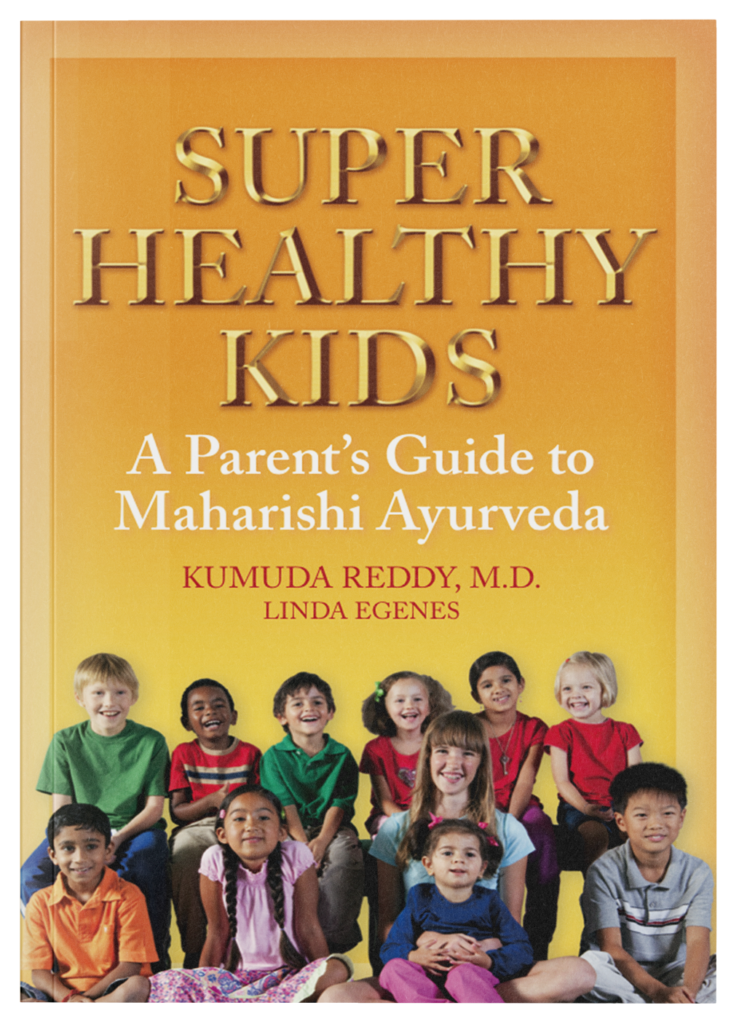
Super Healthy Kids: A Parent's Guide to Maharishi Ayurveda by Kumuda Reddy, M.D., and Linda Egenes

Here is my friend Jane Dean’s book review of  SUPER HEALTHY KIDS: A PARENT’S GUIDE TO MAHARISHI AYURVEDA. Jane  is a writer and former radio host who is the executive assistant to the Director of Maharishi  School of the Age of Enlightenment and mother of two. In the past three years she has traveled to 17 different countries to promote Consciousness Based Education.

Personally, I loved this book.  Everything I learned about Maharishi Ayurveda over 20 years is comprehensively explained in Super Healthy Kids.  I advise you to read it through once and then take another stroll through each chapter (with a marker and some post-it notes). Dr. Reddy and Linda Egenes make a good argument that Maharishi Ayurveda is an effective, sensible and cost effective approach to taking care of children.   It is simple to read for the newcomer to Maharishi Ayurveda.  It is also great for parents who need a reference guide on Ayurveda. Super Healthy Kids is packed with patient’s stories, simple charts and scientific research.  Among its advantages the book has great recipes and a charming bedtime story.

Throughout the book Dr. Reddy tells the stories of her patients, all children, who have benefited from Maharishi Ayurveda mostly with a simple change of diet or a change in daily routine.  The book is, in fact, a text on a complex ancient health care system so it is not light reading.  Dr. Reddy describes how the doshas (the three dominant trends in the human body) emerge from the five elements.  She then elaborates on why each child is a unique individual with a unique health profile.  Dr. Reddy gives a detailed overview of the biology and sequence of digestion and assimilation.  This fascinating but exhaustive detail helps the parent understand the vital role good digestion plays in creating the building blocks that create healthy blood, healthy fat, healthy muscles and healthy bone tissues in a growing child.

Dr. Reddy and I relax together during her visit to Fairfield in June 2011

There are four complete chapters dedicated to the ideal daily routine of a child.  They include bedtime routines, wake-up routines and exercise.  Reddy goes a bit further and explains that a cohesive and peaceful family environment is fundamental.  She backs up her arguments against TV and video games with scientific research on the brain and recommends cultivating a softer, richly stimulating family environment.

Reddy and Egenes give a fresh perspective on the prevention of sickness. They show us how Maharishi Ayurveda health and life style habits create health in childhood and beyond.

Eco-Art and Solastalgia
February 6, 2011
Joy Kreves and Linda Egenes with Solastalgia

Joy Kreves and I with the landscape view of Solastalgia

Last fall I traveled to New Jersey to see my friend Joy Kreves and her solo eco-art show, Translating Nature, at Rider University Art Gallery. Joy has been a transforming influence in my life since high school (I credit her with introducing me to two life-long passions—vegetarianism and Transcendental Meditation), so this trip was a chance to reconnect and renew our friendship. It also was a chance to see firsthand the profound and provocative art Joy creates.

The focal piece of the exhibition was a breathtaking 24-foot-long mixed media piece called Solastalgia. Coined by the Australian philosopher Glenn Albrecht in 2003, solastalgia is “the kind of melancholia or homesickness you have when you remain locked in your home environment while all around you, your home environment is being desolated in ways that you cannot control.”

Since the exhibition, I have been thinking a lot about my own solastalgia, which hit me most strongly when I was a teenager growing up in the western suburbs of Chicago (which is also where I first met Joy). I lived five miles from town in a climax oak forest, but at that time our idyllic rural world was being swallowed up by rampant development, which threatened the oak trees and replaced farms, forests, and horse pastures with houses and shopping strips. I spent a lot of time biking down country roads and wishing that it could all stay pristine and untouched by man. I even made a short film on this theme, in which the leading actor (played by my pretty sister) was trapped in a parking lot of cars and finally escaped to a beautiful meadow. I could have named that film “Solastalgia” but I didn’t know about that word until I attended Joy’s show.

For Joy—who walks daily beside the Delaware River with her dog, Buffy—her beloved river (which is currently being destroyed by gas drilling operations) is a symbol of solastalgia and a source of inspiration for her art. Using found objects from the river, such as branches, stones, leaves and moss—combined with natural yarns, ceramics and watercolor paintings—Joy makes a sweeping statement of the fragile beauty of nature and her personal connection to it.

Joy speaks to students about her ceramic piece, Spring Exuberance

“I recognize more and more how precious our natural environment is, and how it colors and shapes our life,” Joy says. “How people see and what they see is colored and clouded by their memories and their internal narrative. I am trying to translate my experiences of nature into a layered and materially inclusive language. I hope that my translation meets the viewer in an integrated way so as to awaken in them the gratitude that I feel for these rich connections to nature.”

I was amazed at the number of original works that Joy created in the few months leading up to the exhibition, which filled two spacious rooms. I also was inspired by  the variety of media she uses, including ceramics, fur, yarn, painting, sculpture, poetry and found objects from nature.

Joy is also interested in the relationship between quantum physics, consciousness and art, which she explores in her blog, Little Bang Theories. My all-timefavorite piece of hers is “Electron Madness,” which includes a whimsical internal dialogue between herself and electrons.

Thank you, Joy, for thinking deeply about the things that matter and for creating such beauty for my life personally and for everyone who views your work.

Electron Madness by Joy Kreves

As Green As It Gets
November 21, 2010


The Iowa Source cover story on MUM’s SLC written by Linda Egenes

Building the Future: MUM’s Sustainable Living Center
New Zero-carbon Classroom Showcases Green Living
http://www.iowasource.com/fairfield/2010_11_slc.html

Sustainable Living Center: It Takes a Team to Go Green
http://www.iowasource.com/fairfield/2010_11_slc_team.html

I love it when you happen into a sustainability pocket while you’re traveling. Last summer my husband Tom and I were vacationing in Traverse City, Michigan, with our niece Carina. Here’s what I wrote in my journal about the trip.

July 21, 2010

We’ve swapped houses for the week with our friends Joe and Victoria, and feel like we’ve landed in heaven at their beautiful lake home.

My husband Tom and our niece Carina enjoy the outdoor ambiance of Wellington Street Market

They’ve left a flyer on the table for the Wellington Street Market, so we check it out. It’s at the eastern edge of the historic and charming Front Street area in Traverse City, just a block away from Lake Michigan. We know we are going to love this place when we pull up to a white clapboard house with a porch and two picnic tables under umbrellas in front. (Especially since we’ve just spent half an hour trying to track down a Thai restaurant, only to find ourselves in soul-less suburbia.) As Carina so aptly says, “You can eat in a strip mall any day, but when was the last time you had a chance to eat at the Wellington Street Market?”

It was when I am trying to figure out the vegetable portion of the meal to go with my Kurry Guru that I discover the true nature of this restaurant.

“We can’t serve Mattar Panir (peas and fresh cheese) yet because we’re just starting to get the local peas in,” the woman behind the counter says.

Jennifer Blakeslee, co-owner and chef at the Wellington Street Market

It turns out that the woman behind the counter is none other than Jennifer Blakeslee, the co-owner and chef, with Eric Patterson, of two sustainable and local food restaurants—this casual Wellington Street Market and the elegant Cook’s House a block away by the river. The two are also local celebrities, with their own cookbook (The Cook’s House) and liaisons with celebrity chef Mario Batali, the guy who wears the orange clogs and traveled with Gwyneth Paltrow through culinary Spain for their book, Spain: A Culinary Road Trip.

“Have you been to India?” Tom asks Jennifer, noting the abundance of Indian entrees on the menu. It turns out she’s been to some of the same places we’ve visited there, and she tells us about her amazing six-week trip, when she was the guest of Indian friends and was feted with three-hour feasts wherever she went.

“When they heard I was a chef they so generously laid out the food,” she says. “My biggest problem was getting into the kitchen, which is where I wanted to be. My gracious hosts considered it an insult, since I was their honored guest, but after a few days I made my way in.”

So at Jennifer’s recommendation, we order the spicy aloo gobi (cauliflower and peas) curry, along with the root vegetable salad, which consists of fresh local greens topped with roasted sweet potatoes and beets, dollops of goat cheese and a light olive oil and herb dressing.  We eat under the picnic table with the umbrella and are divinely happy.

Jennifer also clues us into a Food for Thought festival of local and organic food vendors that we can attend, and it turns out Mariam, the helper behind the counter who serves our food, is friends with people we know from our hometown of Fairfield, Iowa.

I love making connections like this.

Mariam tells us about Oryana, a natural food market, and after a swim in Lake Michigan at a small, unpopulated beach that Jennifer directs us to via a quaint foot bridge that goes over the river and under the highway, we stock up on a few items there, including local yellow zucchini, local basil  and local peas.

Back home Carina blends up a light, delicate pasta sauce of basil, blanched almond, sea salt and two cloves of garlic. It’s awesome on the pasta with crisp green Cerignola olives and sheep-milk feta, and when paired with the bright colors of yellow zucchini and green peas, we have a locally grown feast of our own.

Next food mission of our trip: pick local fruit and eat it. That shouldn’t be hard, being northern Michigan, the home of the best-tasting strawberries, cherries, blueberries and raspberries in the world. The cherry season just ended, so we’re banking on raspberries.

During the past twenty years, the average American diet has become substantially higher in saturated fats and trans-fats, and deficient in fruits, vegetables, and whole grains. Meals, snacks, and fast foods consumed by children reflect this trend. For instance, a typical serving of french fries contains more than 13.2 percent hydrogenated oil, and a serving of potato chips contains 39 percent partially hydrogenated fat. Government school lunches have been found to contain more than one- third of their calories in fat, and it’s usually the unhealthy type of fat.

These unhealthy fats are taking a toll on the health of American children. Forty percent of five- to eight-year-olds show at least one heart disease risk factor, such as elevated cholesterol, hypertension, or obesity. In the past, arteriosclerosis rarely appeared until after age thirty. Now it is showing up in some children as young as age five.

Key 1. Avoid Trans Fats

Unhealthy fats such as trans-fats, contained in almost all packaged foods, have been shown to increase cholesterol, decrease the good (HDL) cholesterol, clog the liver’s waste-removal system, and block the assimilation of essential fatty acids. In many foods, trans-fatty acids make up 60 percent of the food, yet they contain less than 5 percent essential fatty acids. Trans-fats are made from hydrogenating (adding a hydrogen molecule) to vegetable oil to make it solid. This process of hydrogenation changes the molecular structure of the fat, making it literally indigestible by the human body. Hydrogenated fats in packaged foods may be a major contributor to the high cholesterol levels found in American children today. These fats also create toxins (ama) in the body, since they do not fit the body’s molecular framework and cannot be digested. They disrupt the natural balance of body, because they do not fit the specific requirements of the digestive system.

Hydrogenated and partially hydrogenated vegetable oils are found in almost all packaged goods available at your grocery store, including shortening, margarine, baked goods, candies, chocolate, crackers, chips, cookies, soup mixes, and breads. It’s also contained in deep-fried foods, convenience foods, and fast foods such as french fries.

Just because a package is labeled “low in fat” doesn’t mean that’s so. Many foods labeled “low in cholesterol” contain hydrogenated vegetable oils, and thus are actually high in cholesterol and indigestible to humans. Avoid buying these foods. If you must buy packaged breads or other foods, try your local health food store. Many of the foods sold there will contain fats that are not hydrogenated. Be sure to check the labels.

Key 2: Avoid Oxidized Fats

Other types of fats to avoid are oxidized fats. Aged, processed foods contain oxidized cholesterol, oils, and fats, which means that air has been pushed into them during their processing. These foods include meats, sausages, aged cheeses, fried convenience foods, and stored foods. Especially because they are lacking in the antioxidant minerals and vitamins that fresh foods contain, these are the foods that build up fatty wastes in the arteries and create damage. Also, if you serve your child fresh, whole foods you will avoid serving him oxidized fats altogether. Saturated fats, found in large proportions (up to 60 percent) in animal meats, are associated with heart disease, arteriosclerosis, and other health problems later in life. With a vegetarian diet, these harmful fats can be avoided.

Key 3. Feed Your Child Healthy Fats

Some parents are confused about fats, thinking that they should limit fats even in very young children in order to keep their cholesterol down. This can be very damaging to the child, and can even cause “wasting disease.” The brain itself is over half fat by weight. At birth a newborn’s brain contains only 30 percent of the billions of brain cells that it will need as an adult. Your child’s brain acquires 95 percent of its brain cells by age eighteen months—a phenomenal rate of growth.

In contrast, adults need less than 30 percent of their diet to contain fat. Thus infants and children under three years of age need high-fat diets
to grow properly, and this is best provided through mother’s milk, cow’s milk, and ghee.

Besides feeding your child’s growing brain, fat is essential for building the bones and muscles. Fats help membrane development, cell for- mation, and cell differentiation. Fat protects against mutations in the cells and contains antioxidants.
But it’s essential to choose healthy fats that do not raise LDL cholesterol or create other imbalances in the body. As we mentioned above, Maharishi Ayurveda recommends ghee as the most healthy and wholesome cooking oil and as a spread to replace butter. Healthy sources of fats to include in your child’s diet (in moderation) include olive oil, ghee, avocado, nuts and seeds and green leafy vegetables.

Remember that when it comes to children, they will be more influenced by what you do than what you say. If you eat foods that are wholesome and fresh, your child will be much more likely to eat a healthy diet, too.

First in a series, excerpted from the newly released book Super Healthy Kids: A Parent’s Guide to Maharishi Ayurveda by Kumuda Reddy, M.D. and Linda Egenes, Maharishi University of Management Press, 2010, available at www.mumpress.com.

Older Posts »